
What is Passive House?
Passive House is a building standard that focuses on creating homes that are exceptionally comfortable, energy efficient and healthy to live in. Developed in Germany, the Passive House standard is recognised worldwide and is widely regarded as the gold standard for low-energy building design.
A Passive House home typically requires up to 90% less energy for heating than a traditional UK home. This is achieved not through complicated technology, but through careful design and attention to the building fabric itself
The Key Principles of Passive House Are Simple:
High levels of insulation
Excellent airtightness
Elimination of thermal bridges
High-performance windows and doors
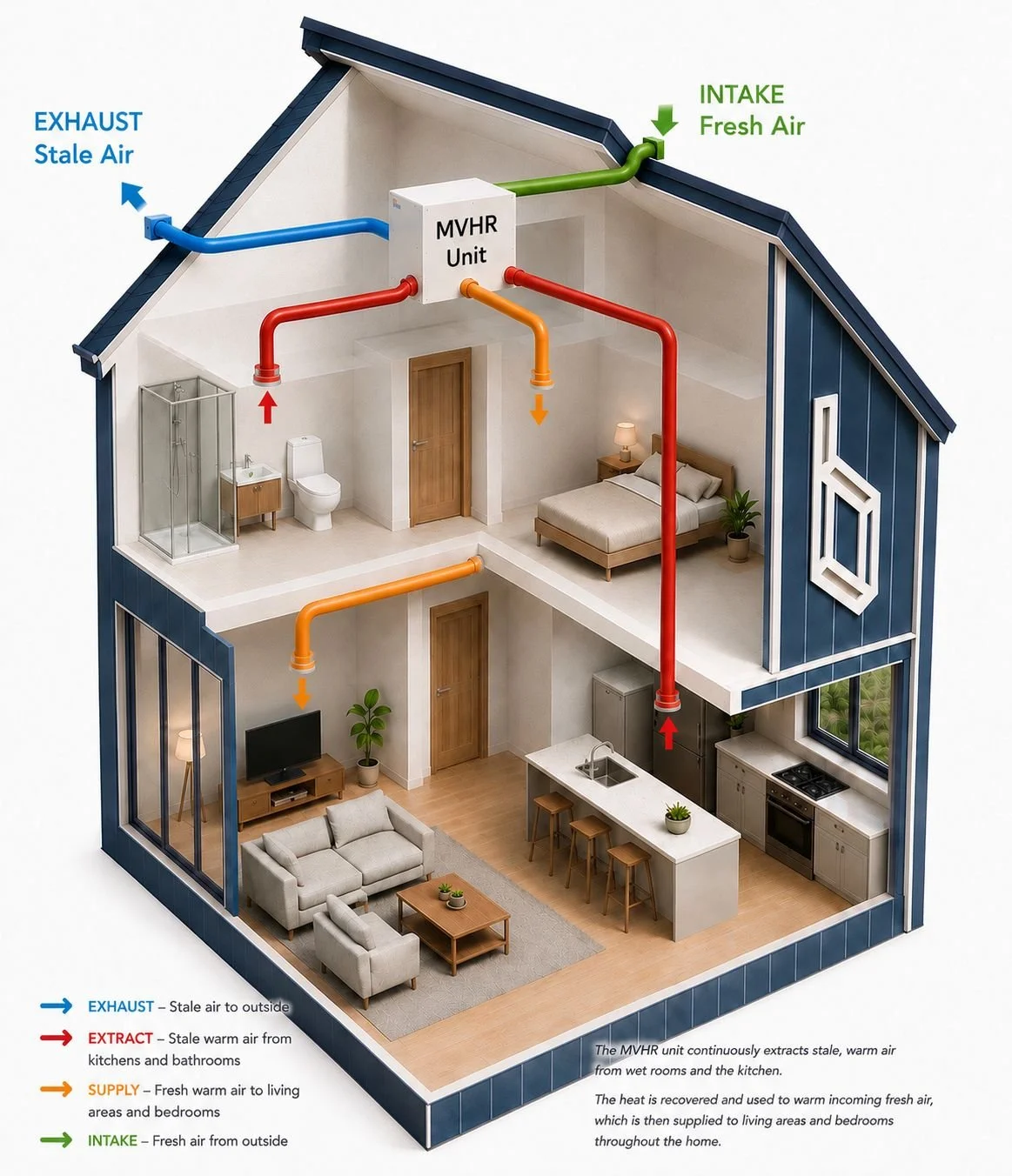
Mechanical Ventilation with Heat Recovery (MVHR)
Together, these elements create homes that remain warm in winter, cool in summer and comfortable throughout the year.
Super Insulation
One of the foundations of Passive House design is a highly insulated building envelope.
Walls, roofs and floors are designed to significantly reduce heat loss, helping to maintain a stable internal temperature with minimal heating input.
Timber frame construction is particularly well suited to this approach, as it allows large amounts of insulation to be incorporated within the structure itself.
At Broadaxe Timber Frames, we typically use highly insulated timber frame wall systems designed to achieve excellent thermal performance while remaining practical to construct.
The result is a home that stays warmer for longer and requires far less energy to heat.
Airtightness - Keeping The Heat Where It Belongs
Insulation alone is not enough.
A poorly sealed building can lose large amounts of heat through gaps around junctions, services, windows and doors. Even small air leaks can have a significant impact on energy performance and comfort.
This is where airtightness becomes critical.
Airtightness refers to how effectively unwanted air leakage is prevented through the building fabric. A well-designed airtight layer ensures that heat remains inside the building rather than escaping through hidden gaps and cracks.
In addition to reducing energy consumption, good airtightness also helps:
Eliminate draughts
Improve comfort
Reduce external noise
Improve moisture control within the building fabric
Improve overall building performance
Achieving excellent airtightness requires careful detailing, quality materials and attention to workmanship throughout the construction process.
Mechanical Ventilation With Heat Recovery (MVHR)
One of the most common questions people ask is:
"If the building is airtight, how does fresh air get in?"
In a traditional home, extractor fans remove warm, stale air from kitchens, bathrooms and utility rooms and simply discharge that heated air outside. Fresh air then finds its way back into the building through vents, gaps and draughts.
A Passive House or low-energy home works differently.
An MVHR system continuously extracts stale air from kitchens, bathrooms and utility spaces, just as a traditional extraction system would. However, instead of simply throwing that warm air away, the system recovers the heat before the air leaves the building.
That recovered heat is then used to warm fresh filtered air, which is supplied to living rooms, bedrooms and other habitable spaces.
This means the home receives a constant supply of fresh air while retaining much of the heat that would otherwise be lost.
Benefits of MVHR include:
Constant supply of fresh filtered air
Reduced heat loss
Improved indoor air quality
Reduced condensation and mould risk
Lower heating demand
Increased comfort throughout the home
Many homeowners are surprised by how fresh, comfortable and consistent the internal environment feels compared to a traditionally ventilated home.
Why Timber Frame Works So Well For Passive House
Timber frame construction is one of the most effective methods of achieving Passive House levels of performance.
The precision of offsite manufacture allows excellent control over insulation, airtightness and detailing. Timber frame structures also make it easier to create highly insulated wall build-ups without excessively increasing wall thickness.
At Broadaxe Timber Frames, we combine high levels of insulation with dedicated airtightness and vapour control layers, helping to create a building fabric that is both energy efficient and durable.
Our systems are designed around the principle of managing moisture correctly within the wall construction. By combining airtight construction internally with breathable materials externally, moisture can be managed safely while maintaining excellent thermal performance.
This approach draws upon both modern building science and traditional construction principles, helping to create homes that are comfortable, efficient and built to last.
Is Passive House Right For Every Project?
Not every project needs to be formally certified as Passive House.
Many clients choose to adopt Passive House principles without pursuing certification. By focusing on high levels of insulation, excellent airtightness and effective ventilation, it is possible to create homes that are significantly more comfortable and efficient than standard building regulations require.
Whether pursuing full Passive House certification or simply incorporating Passive House principles into a project, the result is often the same: lower energy bills, improved comfort, better indoor air quality and a healthier living environment.
At Broadaxe Timber Frames, we work with architects, self-builders and developers to create high-performance timber frame structures designed around these principles, helping clients achieve healthier, more comfortable and more energy-efficient homes.